You squat, and the bottom of the rep feels loose. You deadlift, and as the bar gets heavier your lower back starts doing a job that belongs to your whole trunk. You ride the Minuteman at the weekend and walk Mass Ave most evenings, so it is hard to believe the middle is the problem. Usually it is. Force travels from your feet to the bar through your trunk, and if the trunk cannot hold its position, a share of every effort leaks away before it arrives.
Pilates and core training in Arlington with Patrick Doherty, CSCS, is strength work for that middle section: your core and trunk trained to brace, breathe and control movement, written straight into the lifting you already do. Pat coaches men, mostly dads and busy professionals working on fat loss and muscle, one to one from his private coaching practice in Arlington. You can train with him in person in town, fully online, or as a hybrid of the two.
What Pilates and core training in Arlington means here
The word Pilates puts some men off before they read another line, so here is what it means at Tone & Muscle. It is not a stretching routine, not a group workout and not a sideline from your real training. It takes the parts of Pilates that matter most to a man who lifts, slow and exact movement, breathing that supports the body instead of fighting it, and close attention to position, and pairs them with plain strength work for the core. Then the whole thing is pointed at your squat, hinge, press and pull.
Three things sit at the centre of it.
Trunk strength that resists
Under a load, your core’s main job is to stop movement rather than make it: to keep your spine from rounding, arching or twisting while your arms and legs drive the weight. You train the front, sides and back of the trunk to do exactly that, and to keep doing it as the work gets harder.
Breath used on purpose
Most men either hold their breath and hope, or breathe in a way that lets the middle go slack. You learn one pattern for bracing under effort and a calmer, controlled breath for slow work, and you practise both until they happen without a reminder.
Control that shows up under the bar
Every exercise is chosen for what it does to the lifts you already train. Cleaner positions through the middle mean a squat that stays organised at the bottom, a hinge that stays in the hips and a press that does not turn into a backbend.
Why crunches, planks and long rides have not done it
For most men, core work means a few sets of crunches at the end of a workout or a plank held until it shakes. Both train the middle on its own, and under a bar the middle never works on its own. It has to stay steady while everything around it moves, at the moment the effort peaks, with your breath doing something useful at the same time. A crunch teaches none of that. A plank teaches part of it.
Arlington adds its own version of the problem. With the bikeway running beside Mass Ave, a lot of men here are genuinely active. They ride to the train, walk the kids to school and put in long loops on a Sunday. That is good for the heart and the head. It does very little for a trunk that has to resist twisting or hold a loaded position, because pedalling and walking rarely ask it to. Being active and being strong through the middle are separate qualities, and the second has to be trained on purpose.
Then there is the commute. A seat on the way into Cambridge or Boston, a desk for most of the day, the same seat home. By the time you train, the middle is stiff and switched off, and you ask it to hold a heavy bar anyway. It is no surprise when your form goes before your legs do.
Why Arlington men train their middle with Pat
Arlington is Pat’s home market and the place his in-person coaching happens, so for men in town, Pilates and core training in Arlington is the most direct way to work with him. You can read more about training with Pat around town on the Arlington page.
The men who ask about core training here usually arrive in one of three positions. Some already lift and can feel the middle giving out before anything else does. Some are active on foot or on a bike and want strength without giving up the riding. And some spend most of the day sitting, between the commute and the office, and want to start lifting without their lower back taking over every rep. Pat coaches all three the same way: one to one, starting from what your body does today.
For the lifter whose middle leaks
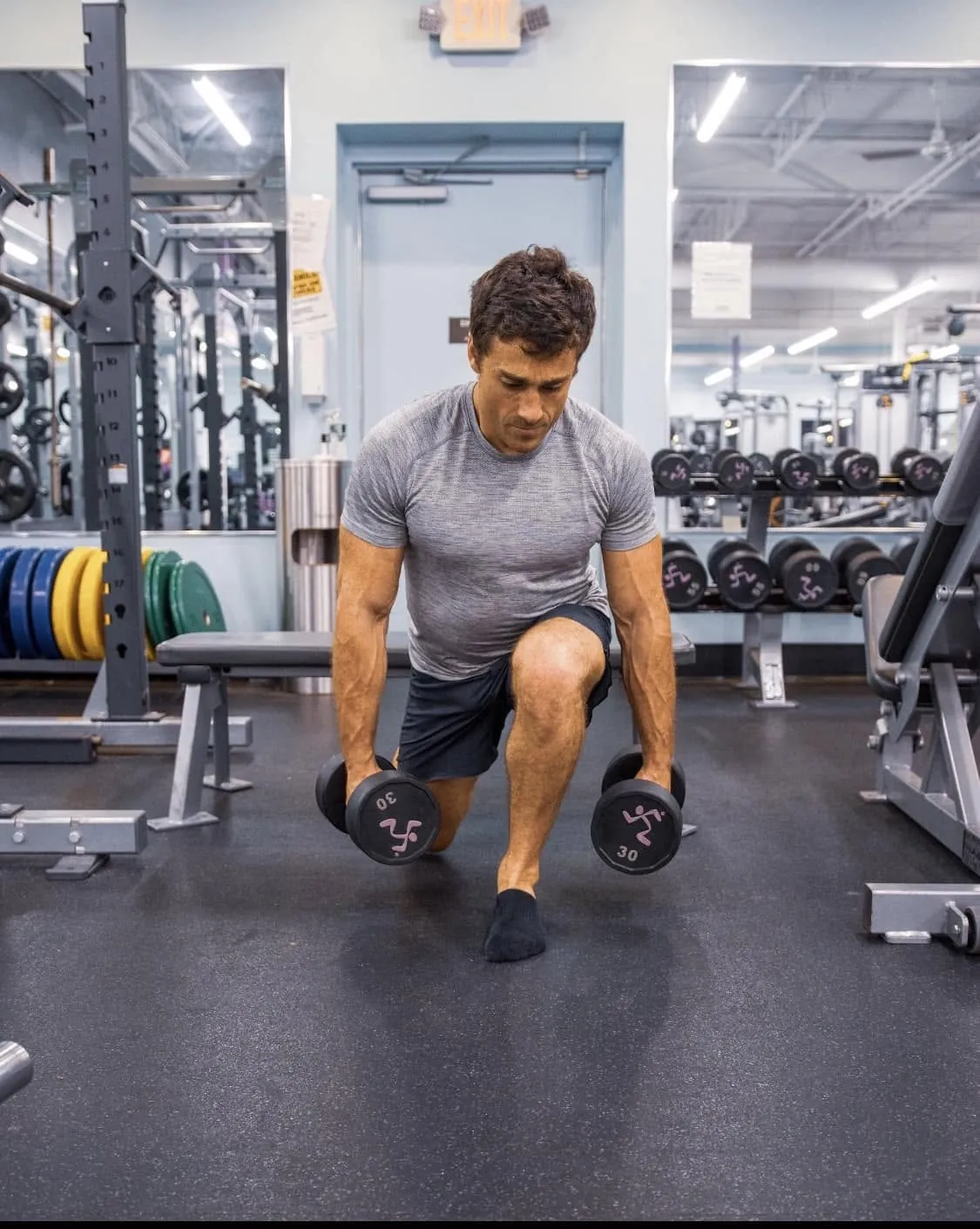
If your chest drops coming out of a squat, or your back rounds as the deadlift gets heavy, the trunk work goes after that exact break point and is judged by how the lift itself changes.
For the rider and the walker
You keep the miles. The core work adds the bracing and control that riding never trains, and a steadier trunk on the bike is a pleasant side effect rather than the goal.
For the man who mostly sits
You start with position and breathing before load. Learning control first means the weight goes onto a body that already knows how to hold it.
What a week of it looks like
Core training here does not normally get a day of its own. It is written into the training you already do, at the points in a session where it helps most.
Some of it comes before your main lifts. A short sequence of slow, controlled trunk work, done with full attention on breathing, wakes the middle up after a day in a chair, so the first heavy set does not catch it asleep. Some of it comes after, as strength work for the trunk itself: positions you hold while your arms or legs move, loaded carries, and movements that ask you to resist rotation or keep your lower back from arching. And some of it is practice inside the lifts, rehearsing the brace on every rep of a squat until it stops needing a reminder.
On the days you do not lift, a little of the floor-based control work can be done at home if it helps. It needs a clear patch of floor and your attention, not a home gym, which matters in East Arlington’s two-families and the capes up in the Heights, where a spare room for equipment is rare.
From one stage of the program to the next, the work progresses the way your lifting does: slower movement, harder positions, more load, less support. When a position becomes easy and clean, it gets harder. When something keeps breaking down, Pat looks at why and changes the approach, instead of asking you to try harder at the same thing.
The thinking behind the work
A handful of ideas shape every piece of core training Pat writes.
- Stability before load. A position you cannot hold without weight will not hold with it. Control comes first, then the load climbs.
- Slow is a tool. Moving slowly removes momentum and shows exactly where you compensate. It is harder than it looks and very honest.
- Breathing is part of the lift. How you breathe decides how well you can brace, so it is coached as a skill rather than left to chance.
- The trunk works as a whole. Front, sides and back, plus the hips and shoulders that attach to it. Training only the muscles you can see leaves gaps.
- Every exercise has a reason. If a movement does not serve a lift or a real task in your day, it is not in the program.
- Progress is reviewed, not assumed. What improves gets harder. What stalls gets changed.
None of this is exotic. It is the same logic as good strength training in general: you overload a quality gradually, you recover from it, and you keep asking a little more of it as it adapts. The difference is that the quality being trained is control through the middle, which most programs leave to chance.
What changes when the middle can hold
Your heavy sets feel organised. Instead of the wobble at the bottom of a squat or the drift on a deadlift, there is a position you know how to find and keep, and you can put full effort into a lift without wondering whether you will hold together.
Your breathing stops being a guess. You have a pattern for every rep, and on the last hard set it is something to lean on rather than something you forget.
The rest of the program gets more out of you. Building muscle and losing fat both depend on training hard enough, often enough, without breaking down along the way. A trunk that does its job lets your legs, back and shoulders do theirs, so the strength you are chasing in the main lifts has a stable base under it.
Ordinary days feel more solid too. Carrying a sleeping child up the stairs of a two-family, lifting the bike onto the car, hauling shopping out of the back seat: the middle that holds you together under a bar does the same job everywhere else.
Who it suits, and who it does not
It suits men who lift and suspect the trunk is their weak link. It suits men who sit for most of the day and want training to feel less like a fight with their own back. It suits men newer to lifting who want control in place before the weight gets serious, and men coming back after a long break who want a sensible base to rebuild from.
It is not the right fit if you want a flexibility routine, a group workout or something gentle to wind down with. It is not a treatment for pain or injury: Pat is a strength coach, and if you have a medical concern, see your doctor first and bring their guidance to your first conversation. And it is not a shortcut to a flat stomach. Training the trunk builds strength and control through the middle, but how lean your midsection looks depends far more on your overall eating and training. That is why Pat coaches core work inside a full fat loss and muscle program rather than as a stand-alone fix.
Coaching without the drive
Core work is one of the easiest parts of a program to carry around, which helps in a town where so many men commute and the early-morning and evening slots are the first to go. There are three ways to work with Pat.
In person in Arlington
The brace and the breath are easiest to learn with a coach beside you, correcting small things you cannot feel yet. For men in town, in-person training in Arlington is the natural place to start, and the place to come back to when something new needs teaching.
Fully online
Once you know the movements, you can do the work in a corner of the living room or at a gym near the office in Cambridge or Boston. Pat reviews how it went and sets the next step.
Hybrid
Learn new work in person, then practise it online on the weeks the commute takes over. It is one program either way, so progress carries across without a restart.
Whatever the mix, the core work lives in the same plan as your lifting and your eating, so it never becomes a separate commitment you have to find room for in an already full week.
How Pat coaches it
Pat’s approach to Pilates and core training in Arlington is to coach the middle as part of the lifting, because that is where it has to do its job. He holds the CSCS credential and coaches men, mostly dads and busy professionals, on fat loss and muscle building. He watches how you squat, hinge, press and carry, finds where your position slips, and writes trunk work aimed at that point. Tone & Muscle is a private coaching practice, not a gym: there is no crowd to blend into and no generic routine to follow, just your program and a coach who knows what you did last time.
How to get started
The first step is a meet and greet, a conversation with Pat about your training, your week and what you want to change. It helps to arrive with a few things already in mind:
- which lifts feel unsteady, and at what point in the rep
- how much of your day is spent sitting, and where
- what training you do now, riding and walking included
- when in the week you can realistically train
- any injury or medical advice you have been given
- whether in person, online or hybrid suits you best
Pat will say plainly whether trunk work is what your training needs and how it would fit. If you are comparing coaches for this kind of work, ask each of them the same question: how will the core work connect to my lifting, and how will we know it is helping? A good answer names your lifts.
Questions about Pilates and core training in Arlington
Is Pilates training only for women?
No. Here it is strength-focused trunk work for men, coached by a strength coach and built into a program for fat loss and muscle. The parts borrowed from Pilates, control, breathing and precision, are exactly what many lifters are missing.
Do I need to be flexible to start?
No. The work starts from how you move today. Control and position come first, and range of movement improves as part of the training rather than being demanded at the start.
I hold planks every session. Is that not enough?
A plank teaches you to hold still. Core training with Pat teaches the trunk to stay braced while you move a load, with the breathing and timing lifting asks for, and it is aimed at the point where your own lifts break down.
I ride the bikeway most weekends. Does that not train my core?
Riding keeps you fit and moving, but it rarely asks your trunk to resist twisting or hold a loaded position. Core training adds that missing piece, and a steadier middle often makes time on the bike feel better as well.
Will core training replace my strength training?
No. It sits inside your strength program and supports it. The trunk work is chosen to help the lifts you already do, not to take time away from them.
Will it flatten my stomach?
Not on its own. Training the trunk makes it stronger and better controlled, but how lean your midsection looks depends mostly on your overall eating and training. That is why Pat coaches core work inside a full program for fat loss and muscle.
Is this physical therapy?
No. It is strength training for the middle, coached by a strength coach with the CSCS credential, and it is aimed at control and performance rather than treating an injury or condition. If you have a medical concern, check with your doctor first.
I live in a two-family with no spare room. Can I still do the work at home?
Yes. Most of the floor-based control work needs a clear patch of floor and your attention. Learn it in person in Arlington first, then carry it into the living room on the days you are not lifting.
The early and evening slots go fast. What if I cannot get one?
Then start online or hybrid. You follow the same program at home or at a gym near work, Pat reviews how it went, and you come in person when a slot opens up.
Do I need to lift already?
It helps, but it is not required. If you are new to lifting, learning control early keeps bad habits from setting in, and your first conversation with Pat covers where to begin.
Book a meet and greet
Call Pat, or book a meet and greet with him. Tell him which lifts feel unsteady, how much of your day is spent in a seat and what training you already do, and he will tell you whether Pilates and core training in Arlington belongs in your plan.